
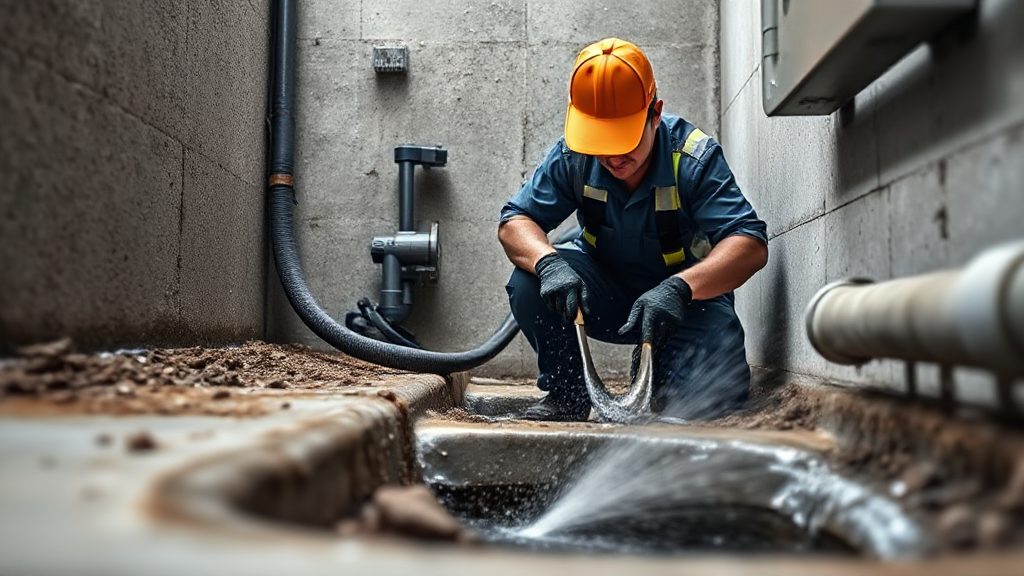
Fix Blocked Drains in Taubaté: A Plumber’s Routine for Real Results
By the end of this routine, you will have a clear, working drain and a short list of habits that keep it that way. I work with a desentupidora Taubaté team, and this is the exact problem-by-problem approach we use on calls across the city — from old center buildings to newer condos in the outlying neighborhoods.
Search intent here is practical: you have a slow sink, a gurgling floor drain, or a backed-up toilet, and you want it fixed without guesswork. Below are the problems we see most often, each with the fix that actually holds.
Problem 1: The Kitchen Sink Drains Slowly and Smells
Grease and soap scum coat the inside of the pipe and narrow it a little more every week. A plunger gives temporary relief, but the coating stays. We start by removing the trap and clearing the visible clog, then run a cable through the branch line to the main stack.
If the smell lingers after clearing, the problem is usually biofilm further down. A short hydrojetting pass scours the pipe wall and removes the layer that causes odors. For a desentupidora Taubaté SP call, this is a common same-day fix because the equipment fits under most sinks.
What we check before we leave
- Hot water flow through the trap to confirm no residual grease.
- Dishwasher discharge line for a second partial clog.
- Vent pipe on the roof for blockage by leaves or nests.
Problem 2: The Floor Drain Backs Up During Rain
This is rarely just a local clog. When a floor drain gurgles or rises during heavy rain, the main line or the connection to the street is partially blocked. We use a camera inspection first to see whether the obstruction is grease, roots, or a collapsed section.
Roots need cutting with a rooter, then hydrojetting to flush the debris. A collapsed pipe needs excavation or a trenchless liner — no amount of plunging will fix it. On one routine job for a desentupidora em Taubaté SP, the camera showed a root mass at a joint; cutting and jetting restored full flow in under two hours.
Signs the main line is the culprit
- Multiple fixtures drain slowly at the same time.
- Water rises in the shower when the toilet flushes.
- A sewer smell appears in more than one room.
Problem 3: The Toilet Overflows and Plunging Fails
A toilet that overflows repeatedly usually has an obstruction past the trap — often wipes, a toy, or a buildup of paper in an older low-flow fixture. Plunging only pushes water back and forth. We pull the toilet if needed and cable the branch line, then check the vent.
If the blockage is in the main line, every flush in the house adds pressure. That is when an emergency call matters: a 24-hour response prevents sewage from backing into other drains. We isolate the fixture, clear the line, and test with multiple flushes before closing up.
What not to do
Do not pour chemical drain cleaner into a fully blocked toilet. It sits in the bowl, can damage the wax ring, and creates a hazard for whoever opens the pipe later. Mechanical clearing is safer and faster.
Problem 4: The Septic Tank Smells or Fills Too Fast
A septic system that needs pumping more often than expected usually has a blocked inlet or a saturated drain field. We inspect the inlet baffle first, then pump and check the outlet. If the field is saturated, pumping alone will not solve it — the field needs rest or repair.
For homes on the edge of the city, this is often the difference between a quick fix and a recurring bill. A preventive pump every two to three years is cheaper than replacing a drain field. We also check for rainwater infiltration into the tank, which is a common cause of fast filling in older properties.
Routine maintenance we recommend
- Pump the tank on schedule, not only when it backs up.
- Keep grease, wipes, and harsh cleaners out of the system.
- Inspect the inlet and outlet baffles annually.
Problem 5: The Condo Stack Is Blocked and Several Units Are Affected
In multi-story buildings, a blocked stack shows up as backups on lower floors. The fix is not in the individual unit — it is in the vertical line. We coordinate with the building manager, access the cleanouts, and hydrojet the stack from the roof or the basement depending on the layout.
This is where a written report matters. We document the camera footage, the location of the blockage, and the condition of the pipe so the condominium has a record for future maintenance. A camera inspection before and after is the only way to prove the line is clear, not just flowing for now.
Comparison: cable vs. hydrojetting
| Method | Best for | Limitation |
|---|---|---|
| Cable/rooter | Solid obstructions, roots, foreign objects | Leaves grease coating behind |
| Hydrojetting | Grease, scale, biofilm, sand | Needs access and water supply |
Frequently Asked Questions
How quickly can a desentupidora arrive in Taubaté?
For emergency calls, response is typically within a few hours depending on traffic and location. We prioritize backups that affect multiple fixtures or risk flooding.
Do I need to be home during the service?
Yes, for residential jobs we need access to the fixtures and the cleanouts. For condominiums, the manager or a responsible person should be present to authorize access to common areas.
Will hydrojetting damage old pipes?
Not when pressure is adjusted to the pipe material and condition. We inspect with a camera first; if the pipe is fragile, we use a lower-pressure method or recommend repair before jetting.
What causes repeated clogs in the same drain?
Usually a partial obstruction that was never fully cleared, a belly in the pipe, or roots at a joint. A camera inspection finds the cause so you are not paying for the same fix twice.

Leave a Reply